
HealthByte 018
This week: COVID-19 interventions reshaped influenza patterns, rats show unique social behaviours with light changes, and childhood obesity in rural China highlights growing disparities.

Welcome to HealthByte, your curated biweekly source for the latest breakthroughs in health and life science!
Bytes of Research
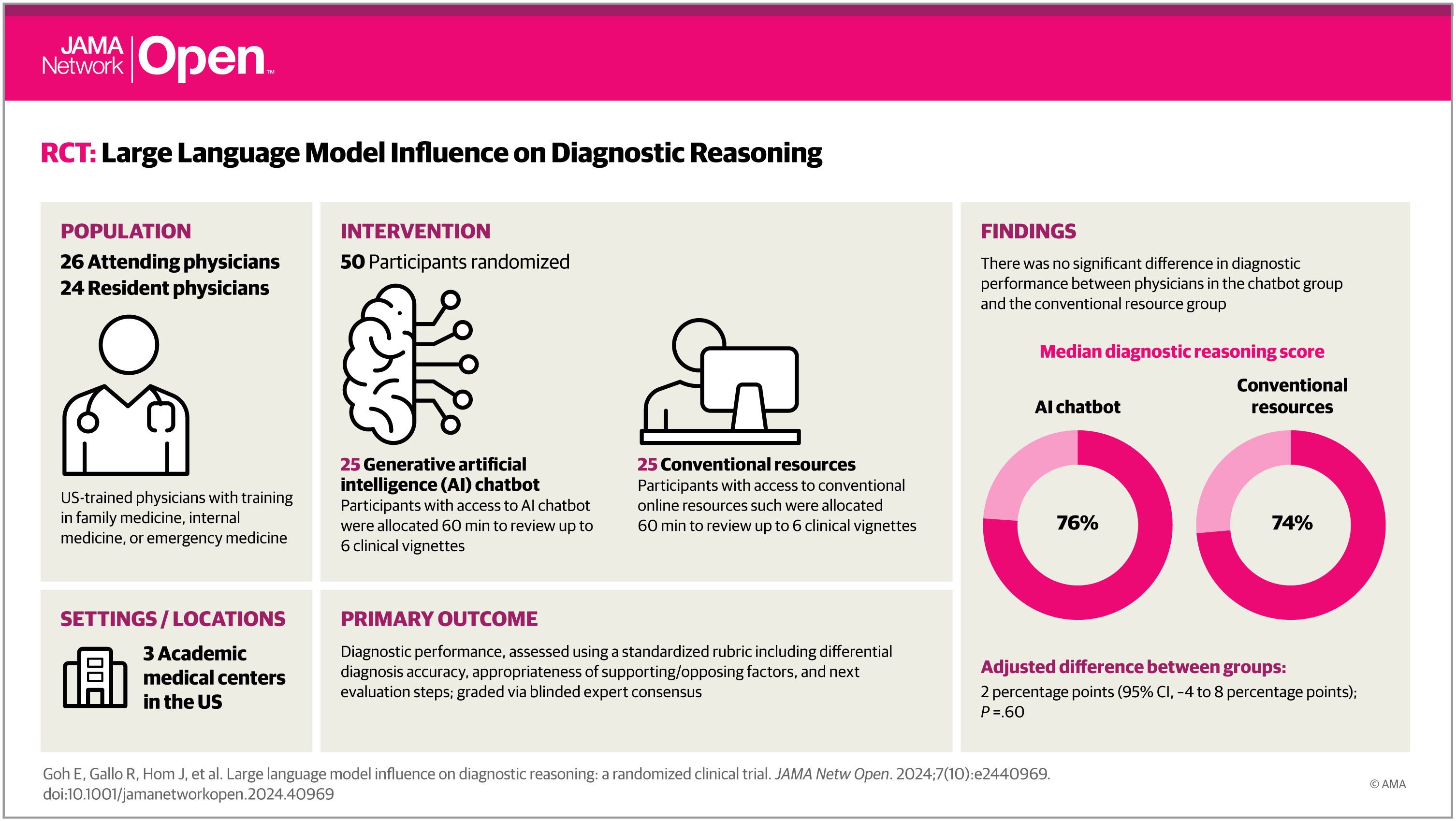
1. Large Language Model Influence on Diagnostic Reasoning: A Randomized Clinical Trial
(JAMA Network Open)
TL;DR: A study found that while large language models (LLMs) alone outperformed conventional diagnostic resources, their integration with traditional methods did not significantly enhance physicians' diagnostic reasoning.
A randomised clinical trial evaluated the impact of large language models (LLMs) on diagnostic reasoning among 50 physicians in family, internal, and emergency medicine compared with conventional diagnostic resources. Participants reviewed clinical vignettes using either an LLM alongside traditional resources or traditional resources alone. Results showed no significant improvement in diagnostic accuracy or efficiency with LLM use (median diagnostic reasoning score: 76% vs. 74%). However, LLMs alone outperformed traditional resources by 16 percentage points. These findings highlight the need for further development to optimise the integration of LLMs into clinical practice to enhance diagnostic performance.
2. A cellular basis for mapping behavioural structure
(Nature)
TL;DR: Neuroscientists found that model mice solve novel problems through medial frontal cortex neurons acting as a homing beacon and by constructing solutions step-by-step rather than all at once.
In a recent study, neuroscientists trained model mice to solve a range of puzzles and evaluated their ability to perform "zero-shot inferences" — making decisions in entirely new, unseen scenarios — as part of a broader effort to quantify a sentient being's capacity to adapt to novel situations. By recording the mice's brain activity, the study was able to link neural activity in the medial frontal cortex to progress to a goal. In general, it was found that the mice used so-called 'memory buffers', to organise their thoughts in order to solve a new problem. Astonishingly however, it was also found that the subject need not encode the entire sequence of goals explicitly, but instead by using the 'goal-progress' neurons to signal when a new step had been reached. The results suggest, that sentient beings solve new tasks iteratively and on the fly, as opposed to constructing the entire solution at once.
3. Trends and inequalities in thinness and obesity among Chinese children and adolescents: evidence from seven national school surveys between 1985 and 2019
(Lancet Public Health)
TL;DR: A study of 1.7 million Chinese children and adolescents (1985–2019) revealed a shift in nutritional inequities, with rising obesity disproportionately affecting rural and socioeconomically disadvantaged regions.
A large-scale study analysing data from 1.7 million Chinese children and adolescents (1985–2019) examined nutritional inequities related to urban-rural residence and socioeconomic status (SES). The prevalence of obesity rose sharply from 0.1% to 8.3%, while thinness declined from 8.5% to 3.4%. Obesity remained higher in urban areas but has increasingly affected rural girls in high-SES regions, while rural boys consistently showed higher thinness rates. By 2019, SES-related disparities in obesity and thinness narrowed, with projections suggesting urban-rural and SES gaps in obesity may reverse by 2030. The findings highlight a shift in nutritional risk in disadvantaged regions from thinness to obesity, underscoring the urgent need for targeted prevention efforts to address growing inequities.

4. Deep learning algorithms reveal increased social activity in rats at the onset of the dark phase of the light/dark cycle
(PLoS ONE)
TL;DR: Researchers link differences in light and darkness to distinct vocalisations and social behaviours in rats, which can be detected through video and audio recordings fed into deep learning algorithms.
Researchers used deep learning algorithms to examine the effect of dark and light periods on sociality in rats. It was possible to quantify movement, posture and social / non-social behaviours using a combination of video and audio data. It was found that that change from light to darkness was able to induce aggressive behaviours, along with alarm and short vocalisations with a distinct audio signature. On the other hand, the change from darkness to light induced more general, less aggressive behaviours such as anogenital sniffing and rearing behaviours.
In addition, it was found that the rats exhibited gradual adaptation to their new environments, through vocalisations at a lower pitch, as well as grooming and rearing behaviours, but not fighting. In general, it was found that in rats, lack of light can induce aggressive behaviour, and sheds some light on how unique vocalisations can reflect their emotional state and well-being.

5. COVID-19 pandemic interventions reshaped the global dispersal of seasonal influenza viruses
(Science)
TL;DR: A study found that while global influenza circulation sharply declined during the COVID-19 pandemic, lineages persisted in regions with fewer restrictions, resuming pre-pandemic patterns as air travel recovered, underscoring the virus's resilience and the need for continued surveillance.
A comprehensive study examined how global influenza dynamics were reshaped during the COVID-19 pandemic, focusing on the effects of unprecedented public health measures and behavioral changes. Researchers used phylodynamics analysis, combining molecular, epidemiological, and travel data, to track influenza circulation. During the pandemic's acute phase (April 2020 to March 2021), influenza test positivity dropped by over 95%, with influenza A persisting in South Asia and influenza B/Victoria emerging from West Asia, regions characterised by tropical climates and fewer restrictions.
As international travel resumed by 2023, the global circulation of influenza intensified, coinciding with waves of SARS-CoV-2 Omicron, and influenza lineages returned to pre-pandemic patterns, albeit with smaller transmission scales. The findings underscore the resilience of global influenza circulation despite prolonged disruptions, emphasising the importance of genomic surveillance to monitor influenza evolution and the potential for other respiratory pathogens to display similar dynamics in future pandemics.

Other pieces we’ve been reading this week!
AI protein-prediction tool AlphaFold3 is now more open: The code underlying the Nobel-prize-winning tool for modelling protein structures can now be downloaded by academics. (Nature)
Once thought a fantasy, effort to sequence DNA of millions of species gains momentum: Project has read 3000 genomes but needs billions to finish grand vision of sequencing all complex life. (Science)
The cochlear question: As the hearing parent of a deaf baby, I’m confronted with an agonising decision: should I give her an implant to help her hear? (Aeon)